JSS 2 PHYSICAL & HEALTH EDUCATION LESSON NOTES
FIRST TERM
|
Week
|
Topic
|
Content
|
|
1
|
Posture
|
Meaning of Posture
|
|
2
|
Posture
|
Appropriate Posture in Sitting, Standing, Walking and Lifting
|
|
3
|
Postural Defects
|
Types of Postural Defects
|
|
4
|
Issues & Challenges in Physical & Health Education
|
Meaning, Issues and Challenges
|
|
5
|
Midterm Exams
|
—
|
|
6
|
Human Trafficking
|
Meaning, Health Implications on Victims
|
|
7
|
Midterm Break
|
—
|
|
8
|
Human Trafficking
|
Solutions to Human Trafficking
|
|
9
|
Sports Laws
|
Sports Laws
|
|
10
|
Recreation & Leisure
|
Meaning and Types of Recreational Activities
|
|
11–13
|
Revision, Examination & Closing
|
—
|
WEEK 1: POSTURE I
Meaning of Posture
Posture is the way the body is positioned or carried when a person is standing, sitting, lying down, walking, or performing an activity. It refers to the alignment of the body parts in relation to one another and to the environment.
The human body has natural curves in the spine – the cervical curve (neck), thoracic curve (upper back), and lumbar curve (lower back). Good posture ensures that these curves are maintained in balance without unnecessary strain.
In simple terms, posture is the habitual way a person holds or positions the body.
Types of Posture
- Good Posture
Good posture occurs when the body is well-aligned in a natural position so that the muscles, bones, and joints are under minimal stress.
- Features of good posture include:
- Head held upright, not drooping forward.
- Shoulders level and slightly back.
- Chest slightly forward, not collapsed.
- Abdomen tucked in, not protruding.
- Back straight with natural spinal curves maintained.
- Knees straight, not bent or locked backwards.
- Body weight evenly distributed on both feet when standing.
- Sitting upright with the back supported.
Good posture enhances efficiency of movement, reduces fatigue, and makes the body look smart, attractive, and confident.
-
Poor Posture
Poor posture occurs when the body is improperly aligned, putting undue stress on muscles, bones, and ligaments. It is usually the result of bad habits developed over time.
- Features of poor posture include:
- Slouched or rounded shoulders.
- Forward thrust of the head.
- Protruding stomach or sagging abdomen.
- Uneven hips.
- Drooping chest.
- Bent knees or awkward standing/sitting positions.
Poor posture leads to deformities, backache, fatigue, and loss of confidence.
Importance of Good Posture
Maintaining good posture is very important for both physical and mental wellbeing.
-
Physical Health Benefits:
- Prevents strain on muscles, bones, and joints.
- Prevents body pains such as backache and neck pain.
- Promotes proper functioning of internal organs by giving them enough space.
- Improves circulation of blood and oxygen in the body.
- Ensures proper growth and development, especially during adolescence.
- Reduces risk of deformities such as hunchback or spinal curvature.
-
Psychological and Social Benefits:
- Boosts self-confidence and self-esteem.
- Makes an individual appear smart, attractive, and disciplined.
- Improves body language and communication in social interactions.
- Gives a positive impression to others.
Causes of Poor Posture
Several factors can cause poor posture. These include:
- Weak muscles and lack of exercise.
- Carrying heavy loads, such as school bags on one shoulder.
- Sitting in slouched positions for long hours (e.g., in class or when using the computer).
- Using chairs, desks, or beds that do not support the body well.
- Wearing high-heeled shoes frequently.
- Accidents, injuries, or illnesses that affect the bones or muscles.
- Overweight or obesity which causes strain on the spine.
- Lack of awareness about correct posture habits.
Effects of Poor Posture
Poor posture has several negative consequences:
- Fatigue and tiredness because muscles work harder to keep balance.
- Backache, neck pain, and body discomfort.
- Deformities such as round shoulders, flat chest, or hunchback.
- Difficulty in breathing due to compressed lungs.
- Reduced efficiency in movement and performance of tasks.
- Poor appearance and loss of confidence.
Ways of Maintaining Good Posture
Good posture can be developed and maintained by following correct habits:
- Always stand upright with shoulders back and body weight equally distributed.
- Sit correctly with the back straight, feet flat on the ground, and buttocks at the back of the chair.
- Avoid slouching or bending forward unnecessarily.
- Lift objects correctly by bending the knees, not the waist.
- Sleep on a good mattress that supports the body.
- Engage in physical exercises (such as stretching, swimming, walking, and posture training exercises) to strengthen muscles.
- Avoid carrying heavy loads on one shoulder; balance loads evenly.
- Wear appropriate footwear; avoid high heels for long durations.
- Develop awareness of body alignment in daily activities.
EVALUATION
- Define posture in your own words.
- Differentiate between good posture and poor posture.
- List five features of good posture.
- Mention four causes of poor posture.
- State four effects of poor posture on the human body.
- Identify four ways of maintaining good posture.
ASSIGNMENT
- Write a detailed essay on the importance of good posture to health, personality, and daily living.
- List and explain five effects of poor posture on the human body.
- As a student, suggest five practical steps you can take to improve and maintain good posture in school and at home.
WEEK 2: POSTURE II MEANING OF POSTURE
- Posture is the way the body is positioned, arranged, or carried when performing different activities such as sitting, standing, walking, or lifting objects.
- It involves the alignment of the bones (skeleton), muscles, and joints in a way that ensures the body is balanced, stable, and efficient in movement.
- Good posture does not only refer to “looking straight” but also to the correct positioning that reduces strain on the muscles, ligaments, and joints, thereby preventing tiredness and injury.
- Posture can be of two main types:
- Good (Correct) Posture – when the body is aligned properly and muscles are not strained.
- Bad (Incorrect) Posture – when the body is poorly aligned, leading to unnecessary pressure on muscles and bones.
IMPORTANCE OF GOOD POSTURE
Good posture is very important in daily living and overall health. Its importance includes:
- Prevents pains in the back, neck, and shoulders.
- Reduces the risk of joint problems and deformities.
- Promotes healthy growth and development of the bones and muscles in children and adolescents.
- Helps internal organs (lungs, heart, stomach, etc.) to function well because they are not squeezed.
-
Psychological/Appearance Benefits:
- Makes a person look attractive, smart, and confident.
- Boosts self-esteem and personal presentation in public.
- Helps the body to use energy more efficiently, reducing fatigue.
- Improves balance and stability, preventing falls and accidents.
- Enhances performance in sports, physical activities, and even academic tasks (because good sitting posture helps concentration).
APPROPRIATE POSTURE IN SITTING
When sitting, the following guidelines should be followed:
- Sit upright, keeping the back straight and supported by the chair.
- Keep the shoulders relaxed and not raised or bent forward.
- Both feet should rest flat on the ground or on a small footrest.
- Knees should be bent at a right angle (90°) with thighs parallel to the floor.
- The head should face forward and not be bent too low for long periods (e.g. while reading or writing).
- Avoid slouching, twisting, or sitting on only one side of the buttocks.
- Do not sit for excessively long periods without stretching.
Effects of Bad Sitting Posture:
- Hunched back (hunchback or kyphosis).
- Fatigue and poor concentration.
APPROPRIATE POSTURE IN STANDING
When standing:
- Stand erect and upright, keeping the body balanced.
- Distribute weight equally on both feet; do not rest weight on one leg for too long.
- Feet should be slightly apart, not too close together.
- The head should be up and facing forward, with chin slightly tucked in.
- Shoulders should be held back, relaxed, and level.
- Avoid bending forward or slouching.
Effects of Bad Standing Posture:
- Curved spine (lordosis or scoliosis).
APPROPRIATE POSTURE IN WALKING
Good walking posture means walking naturally, gracefully, and with balance:
- Walk tall with the head upright, looking forward (not always down).
- Keep the back straight and shoulders relaxed.
- Swing the arms naturally by the sides in rhythm with steps.
- Place each foot forward in a straight line, heel first, followed by the toes.
- Maintain a natural rhythm; avoid rushing unnecessarily or dragging the feet.
Effects of Bad Walking Posture:
APPROPRIATE POSTURE IN LIFTING OBJECTS
When lifting objects, especially heavy ones, the following steps should be observed:
- Preparation: Stand close to the object with feet apart for balance.
- Bending: Bend the knees and squat down while keeping the back straight.
- Grip: Hold the object firmly with both hands.
- Lifting: Straighten the knees to lift, while keeping the object close to the body.
- Carrying: Maintain balance by holding the object in front, not far from the chest.
- Avoid: Twisting or bending the waist when lifting, as it strains the back muscles.
Effects of Bad Lifting Posture:
- Back injuries and waist pains.
- Muscle strain.
- Long-term spinal deformities.
CONSEQUENCES OF BAD POSTURE
If correct posture is not maintained, the following negative consequences may occur:
- Health problems: Back pain, stiff neck, joint pain, headaches.
- Bone deformities: Hunchback (kyphosis), swayback (lordosis), or sideways curve of the spine (scoliosis).
- Poor appearance: A person looks dull, lazy, or careless.
- Reduced efficiency: Bad posture makes the body easily tired and reduces productivity.
- Breathing and digestion problems: Poor posture can press on internal organs.
EVALUATION
- Define posture in your own words.
- Mention four importance of good posture.
- Describe the correct posture for sitting.
- State three guidelines for maintaining good posture in standing.
- Explain how objects should be lifted properly.
- List three consequences of bad posture.
ASSIGNMENT
- Draw and label the correct posture for:
- sitting,
- standing, and
- lifting objects.
- Write five daily activities where good posture must be observed.
- Differentiate between good posture and bad posture (at least four points).
WEEK 3: POSTURAL DEFECTS
Types of Postural Defects
Posture refers to the way the body is positioned and carried during standing, sitting, walking, or lying down. A good posture is the correct alignment of the body that places minimal stress on bones, joints, and muscles. A postural defect occurs when the body’s alignment deviates from the natural position, resulting in abnormal curves or positions of the spine, shoulders, or limbs. Postural defects can cause discomfort, poor appearance, difficulty in movement, and in severe cases, health problems.
TYPES OF POSTURAL DEFECTS
-
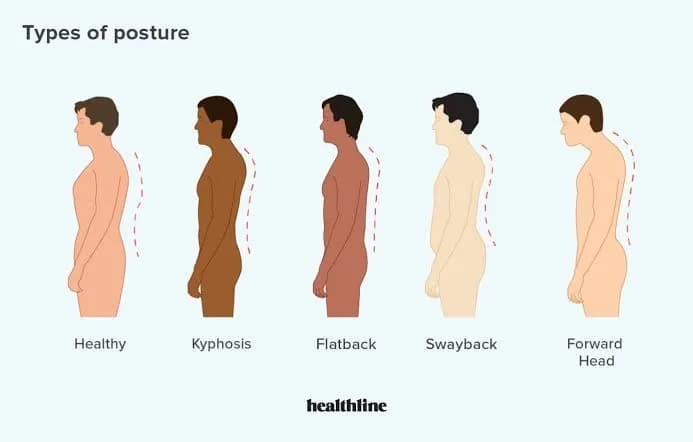
Kyphosis
- An excessive outward curve of the upper spine (thoracic region), leading to a hunchback appearance.
- Causes: poor sitting habits, carrying heavy loads, bone diseases like tuberculosis of the spine.
- Effects: back pain, reduced lung capacity, poor body image.
-
Lordosis
- An excessive inward curve of the lower spine (lumbar region).
- Commonly referred to as “swayback.”
- Causes: obesity, weak abdominal muscles, prolonged poor posture, pregnancy.
- Effects: backache, fatigue, difficulty standing for long periods.
-
Scoliosis
- A sideways curvature of the spine in an “S” or “C” shape.
- Causes: congenital deformities, uneven leg length, carrying heavy loads on one side of the body.
- Effects: uneven shoulders or hips, pain, breathing difficulties in severe cases.
-
Knock Knees (Genu Valgum)
- A condition where the knees touch or angle inward while the ankles remain apart.
- Causes: weak leg muscles, rickets, obesity, genetic factors.
- Effects: awkward walking pattern, knee pain, joint strain.
-
Bow Legs (Genu Varum)
- A condition where the legs curve outward at the knees, leaving a gap between them when standing with feet together.
- Causes: rickets, bone malnutrition, improper walking posture in childhood.
- Effects: imbalance, pain in legs, difficulty in running or walking long distances.
-
Flat Foot
- A condition where the arch of the foot is absent, causing the entire sole to touch the ground.
- Causes: weak foot muscles, prolonged standing, congenital defects.
- Effects: pain in the feet and legs, poor balance, inability to stand for long.
-
Round Shoulders
- A condition where the shoulders are bent forward abnormally.
- Causes: poor sitting posture, long hours of bending over books, use of improper chairs and desks.
- Effects: chest compression, shallow breathing, and poor body shape.
TYPES OF POSTURAL DEFECTS AND THEIR EFFECTS
|
Type of Defect
|
Description
|
Causes
|
Effects
|
|
Kyphosis
|
Outward curve of the upper spine (hunchback)
|
Poor posture, spinal diseases
|
Back pain, reduced lung capacity
|
|
Lordosis
|
Inward curve of lower spine (swayback)
|
Obesity, weak muscles, pregnancy
|
Backache, fatigue
|
|
Scoliosis
|
Sideways curvature of the spine
|
Congenital, uneven legs
|
Uneven shoulders, breathing problems
|
|
Knock Knees
|
Knees bent inward
|
Rickets, weak muscles
|
Awkward walking, joint pain
|
|
Bow Legs
|
Legs curve outward at knees
|
Rickets, poor nutrition
|
Pain, difficulty running
|
|
Flat Foot
|
Absence of arch in foot
|
Weak muscles, congenital
|
Pain, poor balance
|
|
Round Shoulders
|
Forward bent shoulders
|
Poor posture, wrong seating
|
Chest compression, shallow breathing
|
EVALUATION
- Define postural defects.
- List and explain four types of postural defects.
- Differentiate between knock knees and bow legs.
- State two effects of scoliosis on an individual.
- Explain why flat foot can cause pain in the legs.
ASSIGNMENT
- With the aid of diagrams, illustrate any four types of postural defects.
- Explain three causes of kyphosis and suggest two preventive measures.
- Write short notes on the following postural defects: (a) Lordosis, (b) Round shoulders, (c) Flat foot.
WEEK 4: ISSUES AND CHALLENGES IN PHYSICAL AND HEALTH EDUCATION
- Meaning of Physical and Health Education
- Meaning of Issues and Challenges in Physical and Health Education
- Issues in Physical and Health Education
- Challenges of Physical and Health Education
- Possible Solutions to the Issues and Challenges
MEANING OF PHYSICAL AND HEALTH EDUCATION
Physical and Health Education (PHE) is a subject that deals with the development of the human body through physical activities, exercises, games, and sports, while also teaching individuals
how to live a healthy lifestyle. It focuses on physical fitness, mental alertness, social interaction, and the prevention of diseases through knowledge of healthy habits.
MEANING OF ISSUES AND CHALLENGES IN PHE
- Issues are important matters, topics, or concerns that affect the practice, teaching, and learning of Physical and Health Education in schools and society.
- Challenges are difficulties, obstacles, or problems that hinder the effective implementation and growth of Physical and Health Education.
ISSUES IN PHYSICAL AND HEALTH EDUCATION
-
Low Recognition of the Subject
- Many people still see PHE as less important than other academic subjects like Mathematics or English.
-
Shortage of Facilities and Equipment
- Lack of standard sports fields, gymnasiums, balls, nets, and other instructional materials in schools.
-
Inadequate Funding
- Schools and government often allocate little or no funds to promote PHE and sports.
-
Shortage of Qualified Teachers
- Many schools have few or no trained PHE specialists, leading to poor instruction.
-
Cultural and Religious Beliefs
- Some cultures or religions discourage participation in certain games or sports, especially by girls.
-
Low Student Participation
- Many students prefer sedentary lifestyles (e.g., using phones and computers) to engaging in sports and physical activities.
CHALLENGES OF PHYSICAL AND HEALTH EDUCATION
-
Poor Government Policies
- Lack of proper policies and commitment to support sports and health education development.
-
Health Risks and Injuries
- Participants sometimes face accidents, injuries, or illnesses due to poor training or lack of protective equipment.
-
Inadequate Motivation for Athletes and Teachers
- Lack of incentives, rewards, and recognition for both students and teachers reduces interest.
-
Negative Attitude of Parents and Students
- Many parents encourage their children to focus only on “serious” subjects, neglecting PHE.
-
Poor Infrastructure and Maintenance
- Even when facilities are provided, they are poorly maintained, reducing their effectiveness.
POSSIBLE SOLUTIONS
- Government should allocate more funds to sports and health education.
- Schools should provide adequate facilities, equipment, and qualified PHE teachers.
- Parents and communities should support students’ participation in physical activities.
- Awareness should be created about the importance of fitness, sports, and health.
- Maintenance culture should be developed for sports infrastructure.
- Scholarships and incentives should be given to talented students to encourage participation.
EVALUATION
- What is Physical and Health Education?
- Explain the meaning of issues and challenges in Physical and Health Education.
- List and explain four issues affecting Physical and Health Education in schools.
- Mention four challenges of Physical and Health Education.
- Suggest three possible solutions to the challenges of Physical and Health Education.
ASSIGNMENT
- Write in detail five issues that hinder the growth of Physical and Health Education in Nigeria.
- Identify and explain five challenges faced in teaching Physical and Health Education in your school.
- Suggest five practical solutions that can help improve Physical and Health Education in Nigerian schools.
WEEK 6: HUMAN TRAFFICKING
INTRODUCTION
Human trafficking is the illegal act of recruiting, transporting, transferring, harbouring, or receiving people through force, deceit, or coercion for the purpose of exploitation. Victims are often promised good jobs, education, or a better life but are deceived and forced into slavery, prostitution, forced labour, or other inhumane conditions. It is a global crime and a violation of human rights, affecting both young and old, especially women and children.
Here's a powerful, symbolic split image addressing human trafficking:MEANING OF HUMAN TRAFFICKING
Human trafficking means the unlawful movement of people within or across borders for the purpose of exploiting them. It involves acts such as:
- False promises of job opportunities or education.
- Sale of people into forced marriage, child labour, or prostitution.
It is different from human smuggling because trafficking involves exploitation, not just transportation.
HEALTH IMPLICATIONS OF HUMAN TRAFFICKING ON VICTIMS
Human trafficking has severe effects on the health and well-being of victims. These effects can be:
-
Physical Health Problems
- Victims are often subjected to physical abuse, beatings, rape, and torture.
- They suffer injuries, broken bones, and sometimes permanent disabilities.
- They may be denied medical care, leading to untreated diseases and infections.
-
Sexual and Reproductive Health Issues
- Victims forced into prostitution are exposed to sexually transmitted infections (STIs) including HIV/AIDS.
- Early or forced pregnancy may occur, leading to complications.
- Lack of access to proper hygiene and reproductive health care.
-
Psychological and Emotional Problems
- Victims often experience depression, anxiety, trauma, and fear.
- Many develop post-traumatic stress disorder (PTSD).
- Loss of self-esteem, hopelessness, and suicidal thoughts are common.
-
Social and Educational Problems
- Victims are usually denied access to education, leading to illiteracy.
- They are isolated from family, friends, and community.
- Stigma and discrimination make reintegration into society difficult.
-
Economic Consequences
- Victims are exploited for free or cheap labour and earn little or no money.
- They remain in poverty and dependency.
EVALUATION
- Define human trafficking in your own words.
- State two differences between human trafficking and human smuggling.
- Mention four physical health problems faced by victims of human trafficking.
- Explain three emotional or psychological effects of trafficking on victims.
ASSIGNMENT
- Write five reasons why people become victims of human trafficking.
- List and explain four measures that can be taken to prevent human trafficking in Nigeria.
- Discuss the role of government and non-governmental organizations (NGOs) in supporting victims of human trafficking.

 REGIS INTERNATIONAL MONTESSORI SCHOOL