WEEK 6 & 7
CELL AND ITS ENVIRONMENT
OSMOSIS & DIFFUSION
Diffusion is the spontaneous movement of particles (atoms, ions, or molecules) from an area of higher concentration to an area of lower concentration. This movement occurs down a concentration gradient, with the goal of achieving equilibrium, where the concentration becomes uniform throughout the available space.
Process of Diffusion
The process of diffusion involves the random motion of particles. It can occur in gases, liquids, or solids. The speed of diffusion depends on factors such as temperature, particle size, and the medium through which diffusion is taking place.
In gases and liquids, diffusion is facilitated by the constant motion of particles. In solids, diffusion can occur through the movement of atoms or molecules within the structure of the material.
(Diagram Description: A side-by-side comparison illustrating Osmosis on the left—showing water moving across a semipermeable membrane between a solution and pure water—and Diffusion on the right—showing particles spreading out from a high concentration area to a low concentration area.)
Significance of Diffusion
- Nutrient and Gas Exchange: Diffusion is crucial for the exchange of gases (like oxygen and carbon dioxide) in biological systems. It also facilitates the movement of nutrients into cells and waste products out of cells.
- Biological Processes: Diffusion plays a fundamental role in biological processes such as respiration and photosynthesis. In these processes, gases move in and out of cells to support metabolic activities.
- Cellular Uptake of Substances: Cells utilize diffusion to take up essential molecules. For example, nutrients can diffuse across cell membranes to reach cells.
- Chemical Reactions: Diffusion helps in mixing substances, allowing for chemical reactions to occur. In a homogeneous mixture, reactants can come into contact more frequently, facilitating reactions.
- Reversibility
Osmosis
Osmosis can be defined as the movement of water molecules from a region of lower concentration to the region of higher concentration through a semi-permeable membrane.
A permeable membrane allows molecules to pass through it freely while a selectively permeable membrane only allows certain molecules to pass through it. Osmosis will only occur when a semi-permeable membrane separates weak and strong solutions.
Living cells may find themselves in any of the following situation:
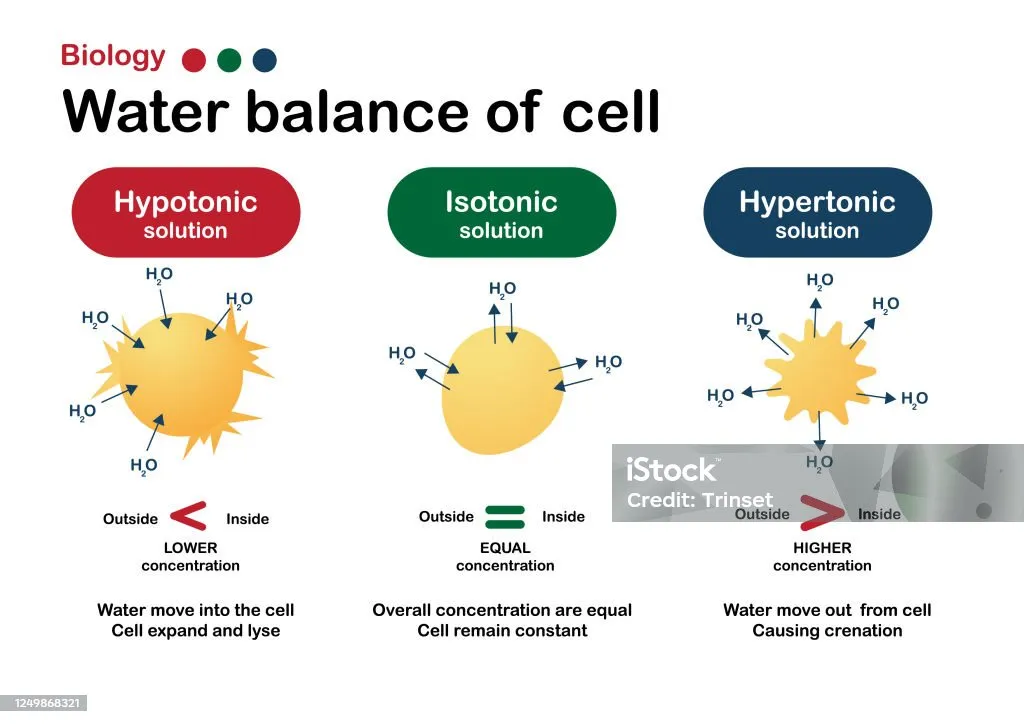
- Hypertonic: When the fluid surrounding the cell is more concentrated than the inside of the cell, the surrounding fluid is said to be hypertonic to the content of the cells. A net movement of water molecules out of the cell into the surrounding fluid occurs and causes the cell to shrink. This process is known as Exosmosis.
- Hypotonic: When the fluid surrounding the cell is less concentrated than the inside of the cell, the surrounding fluid is said to be hypotonic to the content of the cell. There is a net movement of water molecules from the surrounding fluid into the cells. This process is known as Endosmosis.
- Isotonic: When the surrounding fluid and the cell concentration have the same concentration, they are said to be Isotonic. A net movement of water molecule in and out of the cells does not occur.
Importance of Osmosis
- It aids the absorption of water from the soil into the vacuole of the root hairs.
- It aids the movement of water from the root hairs into the cells of other parts of the plants.
- It helps to control the opening and closing of the stomata pores.
- It gives turgidity to the plant cells i.e. it gives support.
- It aids intracellular movement of water in animals.
- It aids reabsorption of water from the kidney tubules into the blood.
- It causes haemolysis of red blood cells.
Plasmolysis
Plasmolysis is generally reversible if the plant cell is placed in a hypotonic (lower solute concentration) environment. In a hypotonic solution, water will move back into the cell, and the protoplast will expand, restoring turgor pressure and the cell's normal state.
- Hemolysis: Hemolysis is the rupture or destruction of red blood cells. This can occur when red blood cells are exposed to a hypotonic solution, causing water to enter the cells and potentially burst them.
- Turgidity: Turgidity refers to the state of a cell when it becomes swollen and rigid due to the absorption of water. This is often observed in plant cells when they are in a hypotonic environment.
- Flaccidity: Flaccidity is the opposite of turgidity. It occurs when a cell loses water and becomes limp, causing it to lose its rigidity. This often happens in plant cells in a hypertonic environment.
- Osmoregulation: Osmoregulation is the process by which organisms regulate the concentration of water and solutes within their cells to maintain internal balance. It involves various mechanisms, including osmosis and active transport.
- Active Transport: Active transport is a process that requires energy (usually ATP) to move molecules against their concentration gradient, from an area of lower concentration to an area of higher concentration. This mechanism is essential for maintaining concentration gradients in cells.
Evaluation
- Explain the following terms: Hypertonic, Hypotonic and Isotonic solution
- State the differences between osmosis and diffusion
- Define diffusion and state factors that can affect it.
- How does endosmosis lead to turgidity?
- Plasmolysis results from exosmosis. Explain.
- Of what importance is diffusion to life?
ASSIGNMENT
- Which structures must be present in a cell for osmosis to take place?
- A. cell (sap) vacuole and cell wall
- B. cell wall and cell membrane
- C. chloroplast and cytoplasm
- D. cytoplasm and cell membrane
- The scent from a bunch of flowers spreads throughout a room. How does the scent spread?
- A. by conduction
- B. by diffusion
- C. by osmosis
- D. by transpiration
- Which of the following environmental conditions is ideal for plant cells to remain turgid?
- A. Hot, dry weather
- B. Cold, dry weather
- C. Cool, humid weather
- D. Windy weather
- Osmosis occurs through a membrane that can be ______ permeable.
- A. Fully
- B. Slowly
- C. Differentially
- D. Freely
- Which of the following processes takes place when a plant cell is put in a hypotonic solution?
- (a) water moves into the cell and the cell bursts
- (b) water leaves the cell and the cell becomes flabby
- (c) water moves into the cell and the cell becomes turgid
- (d) the cell becomes plasmolysed

 REGIS INTERNATIONAL MONTESSORI SCHOOL