
 REGIS INTERNATIONAL MONTESSORI SCHOOL
LESSON NOTE
National Symbols and Their Meanings
Subject:
Citizenship and Heritage Studies
Class:
Year 10
Topic:
National Symbols and Their Meanings
Content Breakdown:
Coat of Arms • Flag • Anthem & Pledge • Currency • Constitution
Duration:
80 minutes (Double period)
Teacher:
Mr Philip Agbede
Learning Objectives
By the end of the lesson, students should be able to:
Identify Nigeria's five major national symbols: the Coat of Arms, the National Flag, the National Anthem and Pledge, the Currency, and the Constitution.
Explain the historical background and meaning of each national symbol.
Describe the colours, features, and symbolism embedded in the flag and coat of arms.
Recite the National Anthem and Pledge and explain the values they promote.
Discuss the importance of the currency and the Constitution to national identity and governance.
Demonstrate respect and patriotism towards national symbols as responsible citizens.
Content Breakdown
1. The National Flag
The Nigerian flag was designed by Michael Taiwo Akinkunmi in 1959 and officially adopted on 1st October 1960 at independence. It has three vertical bands: green, white, and green. The green bands represent Nigeria's rich agriculture and natural vegetation, while the white band in the middle symbolises peace and unity among the different ethnic groups in the country. The flag is flown at government buildings, schools, and during national events as a mark of sovereignty and pride.
2. The Coat of Arms
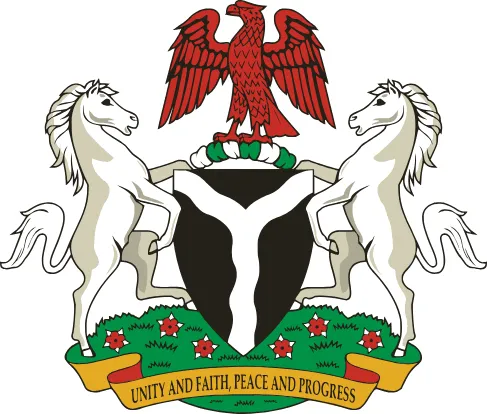
The Coat of Arms is Nigeria's official emblem, adopted in 1960. It features a black shield divided by a white "Y" shape, representing the River Niger and River Benue meeting at Lokoja. The black shield symbolises the fertile soil of Nigeria, while two white horses on either side stand for dignity. A red eagle sits above the shield, representing strength, and a wreath of green and white cotton flowers at the base represents the fertile land. The national motto, "Unity and Faith, Peace and Progress," is inscribed on a banner beneath the shield, reminding citizens of the values that hold the nation together.
3. The National Anthem and Pledge
Nigeria's current National Anthem, "Arise, O Compatriots," (restored in 2024) calls on citizens to serve the fatherland with love, strength, and faith, and to build a nation where peace and justice reign. The National Pledge, recited alongside the anthem, commits every citizen to be faithful, loyal, and honest, to serve Nigeria with all their strength, to defend her unity, and to uphold her honour and glory. Both are usually recited standing, with the right hand raised or placed over the heart, during morning assemblies and official ceremonies, instilling patriotism and civic responsibility in citizens from a young age.
4. National Currency
The Naira (₦) is Nigeria's official currency, issued by the Central Bank of Nigeria (CBN) since 1973, when it replaced the Nigerian Pound. Nigerian banknotes and coins feature portraits of national heroes and heroines, such as Sir Ahmadu Bello, Dr Nnamdi Azikiwe, and Alhaji Sir Abubakar Tafawa Balewa, alongside images that reflect Nigeria's culture and economy. As a national symbol, the currency represents the country's economic sovereignty and identity, and it is used as a medium of exchange in daily transactions across the federation.
5. The Constitution
The Constitution of the Federal Republic of Nigeria (1999, as amended) is the supreme law of the land. It establishes the structure of government, defines the powers and duties of the three arms of government (Executive, Legislature, and Judiciary), and guarantees the fundamental human rights of every citizen, such as the right to life, dignity, freedom of expression, and freedom of movement. As a national symbol, the Constitution represents the rule of law and serves as the foundation upon which justice, order, and democracy are built in Nigeria; every law made in the country must align with its provisions.
Class Activities
Activity 1: Identify and Match
In pairs, students are given printed pictures/flashcards of the five national symbols (unlabelled). They match each picture to its correct name and write one sentence stating what it represents. Pairs present one symbol each to the class.
Activity 2: Recitation and Reflection
As a class, students stand and recite the National Anthem and National Pledge together. In small groups of four, they then discuss and list two values (e.g. loyalty, unity, service) each line of the pledge teaches, and share their answers with the class.
Activity 3: Design Challenge
In groups, students sketch a simple poster titled "Why I Am Proud of My National Symbols," using at least three of the five symbols studied, and briefly explain their poster to the class.
Assignment
Write short answers to the following in your notebook and submit at the next lesson:
Draw and correctly label the Nigerian flag and Coat of Arms.
In not more than 10 lines, write out the National Pledge from memory.
Explain, in two paragraphs, why the Constitution is described as the "supreme law of the land."
Find out and write the names of three Nigerian heroes/heroines featured on the Naira notes.
In your own words, explain why every citizen should respect national symbols.
Practice Questions
Section A: Objective Questions
The white band on the Nigerian flag represents: (a) agriculture (b) peace and unity (c) wealth (d) war
Who designed the Nigerian national flag? (a) Nnamdi Azikiwe (b) Michael Taiwo Akinkunmi (c) Tafawa Balewa (d) Ahmadu Bello
The white "Y" shape on the Coat of Arms represents: (a) the national motto (b) the confluence of River Niger and River Benue (c) the eagle's wings (d) the flag colours
Nigeria's currency is issued by: (a) the Federal Ministry of Finance (b) the National Assembly (c) the Central Bank of Nigeria (d) the World Bank
The supreme law of Nigeria is called the: (a) National Pledge (b) Constitution (c) Coat of Arms (d) Anthem
Section B: Theory Questions
List and briefly explain the meaning of the five national symbols of Nigeria.
Describe the main features of the Nigerian Coat of Arms and what each feature represents.
State the National Pledge and explain any three values it teaches Nigerian citizens.
Why is the Constitution considered the most important legal document in Nigeria?
Explain the importance of national symbols to nation-building and unity.
Lesson Summary / Evaluation
National symbols — the Coat of Arms, Flag, Anthem and Pledge, Currency, and Constitution — represent Nigeria's identity, history, values, and laws. Understanding and respecting these symbols helps build patriotism, unity, and responsible citizenship among young Nigerians. The teacher should conclude by asking oral questions to confirm understanding before assigning the take-home tasks above.