WEEK 6: DEPARTMENTS IN AN OFFICE/ORGANISATION
An organisation is a group of people working together in a structured way to achieve common goals. Every organisation, whether big or small, private or public, needs different sections or departments to carry out various activities. Each department has its own functions but they all work together for the success of the organisation.
The departments in an organisation are like the organs in the human body. Just as the body has the heart, lungs, brain, and stomach performing different functions but working together to keep the person alive, the departments of an organisation work hand in hand to keep the business functioning and growing.
ORGANISATIONAL CHART: COMMON DEPARTMENTS
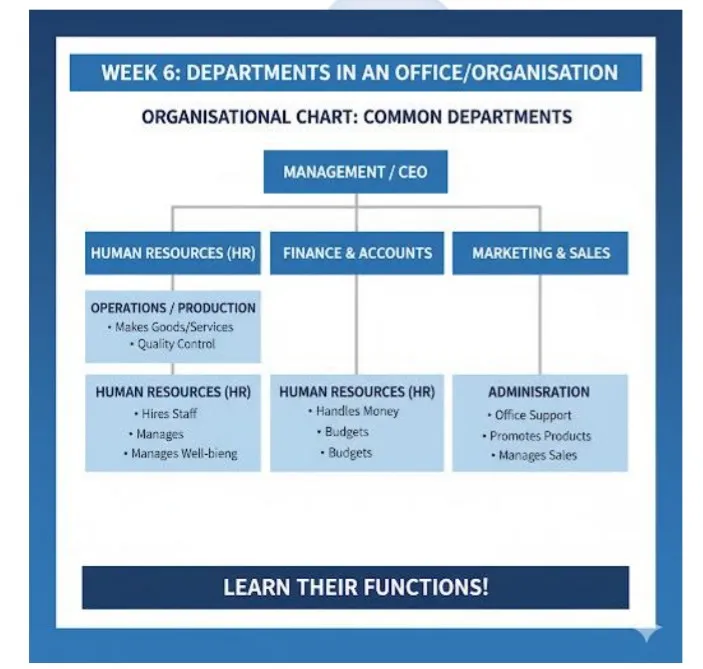
Major Departments in an Organisation and Their Functions
1. Administrative Department
- This is the central coordinating department of any organisation.
- It is responsible for managing office work, correspondence, records, filing, and communication within and outside the organisation.
- The administrative department ensures that the activities of other departments are properly coordinated.
- It supervises staff, organises meetings, and keeps minutes and reports.
2. Production Department
- This department is responsible for producing goods or services that the organisation sells.
- It manages raw materials, machines, and labour to make finished products.
- In a service organisation (like a school or hospital), this department ensures that services are delivered properly.
- It also works with quality control to ensure that goods and services meet acceptable standards.
3. Marketing and Sales Department
- This department is responsible for advertising and promoting the organisation's products or services.
- It researches the market to know what customers need and how to satisfy them.
- It handles distribution and ensures that products are sold at the right time and price.
- The sales unit ensures that money is collected from customers after selling goods and services.
4. Finance/Accounts Department
- This department manages the money of the organisation.
- It prepares budgets, records income and expenditure, and ensures that funds are available for different operations.
- It also calculates profits, losses, and ensures proper accounting records are kept.
- Staff salaries, wages, and allowances are prepared here.
5. Personnel/Human Resource Department (HR)
- This department is in charge of the workers or staff of the organisation.
- It recruits new workers, organises training, and ensures workers are motivated to do their jobs.
- It also settles disputes between workers, maintains discipline, and enforces company policies.
- The welfare of workers, such as health benefits, leave, and promotion, is handled here.
6. Purchasing/Procurement Department
- This department is in charge of buying raw materials, equipment, stationery, and other items needed by the organisation.
- It ensures that items purchased are of good quality and bought at the right price.
- It also manages suppliers and makes sure that goods arrive at the right time.
7. Research and Development Department (R&D)
- This department studies new methods of improving products and services.
- It carries out investigations to develop better and cheaper ways of doing things.
- It helps the organisation remain competitive in the market.
- For example, a phone company's R&D may develop a new smartphone model.
8. Public Relations Department (PR)
- This department manages the image and reputation of the organisation.
- It communicates with the public, the press, and stakeholders.
- It ensures that customers and the community see the organisation in a positive light.
- It also handles complaints from customers and organises events to promote goodwill.
How Departments Work Together
Although each department has specific functions, they are interdependent. For example:
- The production department makes the goods, but the marketing department sells them.
- The finance department provides funds needed by the production department to buy raw materials.
- The HR department recruits and trains workers that will work in production, finance, and other sections.
- The administrative department ensures smooth communication among all departments.
Without cooperation and coordination, the organisation cannot succeed.
Summary
Departments in an organisation include administrative, production, marketing/sales, finance/accounts, personnel (HR), purchasing, research and development, and public relations. Each has its own function but they all work together towards the achievement of the organisation's objectives.
Evaluation
- Define an organisation.
- List five departments in an organisation and state their functions.
- Why is the finance department important to the success of an organisation?
- Explain how the production and marketing departments depend on each other.
- What is the role of the personnel/human resource department?
Assignment
- Draw a simple chart showing at least six departments of an organisation and their relationships.
- Visit a nearby school, hospital, or business centre. Identify at least three departments and describe the roles they play in the success of the organisation.
- In your own words, explain why no single department can work in isolation in an organisation.

 REGIS INTERNATIONAL MONTESSORI SCHOOL