
 The Royal Diadems Schools
In our previous studies, we explored flat two-dimensional (2D) shapes like rectangles and circles, focusing on their perimeter and area. In the physical world, however, objects have depth and occupy space. Mensuration of solid shapes allows us to calculate the space inside these three-dimensional (3D) objects (Volume) and the total area of their outer boundaries (Surface Area). This note focuses on two fundamental solid shapes: the cuboid and the cylinder.
A cuboid is a three-dimensional solid bounded by six rectangular faces. It features 12 edges and 8 vertices. The three primary dimensions of a cuboid are its length (), width (), and height (). When all six faces are equal squares, the cuboid is classified as a cube.

To find the capacity or Volume () of a cuboid, we calculate the area of the rectangular base and multiply it by the height. Because volume measures 3D space, its units are always cubic (e.g., or ):
The Total Surface Area (TSA) is the sum of the areas of all six rectangular faces. Since opposite faces are identical in a cuboid, we group them into three pairs to simplify calculations. Surface area is a 2D measure of the boundary, so its units are square (e.g., ):
Calculate the Volume and TSA of a cardboard shoebox with a length of , a width of , and a height of .
Solution:
Volume:
Total Surface Area:
A cylinder is a solid shape with two parallel circular bases connected by a curved surface. If you unroll the curved surface of a cylinder, it forms a flat rectangle. The width of this rectangle corresponds to the height () of the cylinder, and its length corresponds to the circumference of the circular base ().
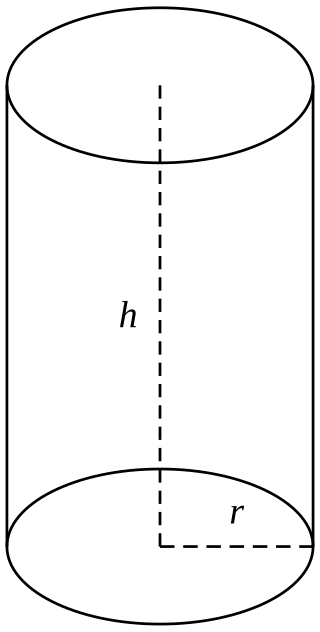
The Volume () of a cylinder is found by multiplying the area of its circular base () by its height ():
The surface area of a cylinder is divided into two distinct components:
(Note: We typically use or for calculations).
Find the Volume and TSA of a closed solid cylindrical tin with a radius of and a height of . (Take ).
Solution:
Volume:
Total Surface Area:
Understanding the properties of 3D solids is essential in manufacturing, packaging, and construction. For instance, food processing companies use volume calculations to ensure that beverage cans hold the exact amount of liquid advertised on the label without overflowing during assembly.
In construction, civil engineers use surface area formulas to determine the exact amount of anti-corrosive paint needed to coat cylindrical bridge pillars, which prevents material waste and keeps projects within budget.
Civil engineers use these geometric formulas to design large municipal water reservoirs, ensuring communities have access to a reliable daily supply. For a quick home-practice activity, find any cylindrical tin of food in your pantry, measure its height and diameter with a ruler, and calculate its volume to see how closely your mathematical result matches the net weight or volume printed on the label.