
 GRUEN INTERNATIONAL SCHOOLS, PORT HARCOURT
Class: Year 10
Topic: What Markets Do
Duration: 2 Periods
Method: Discussion, Explanation, Questioning, Demonstration and Group Work
Instructional Materials: Pictures of traditional and modern markets, product samples, charts, pictures of buyers and sellers, price tags, whiteboard
Reference: Essential Marketing for Senior Secondary Schools; NERDC Marketing Curriculum
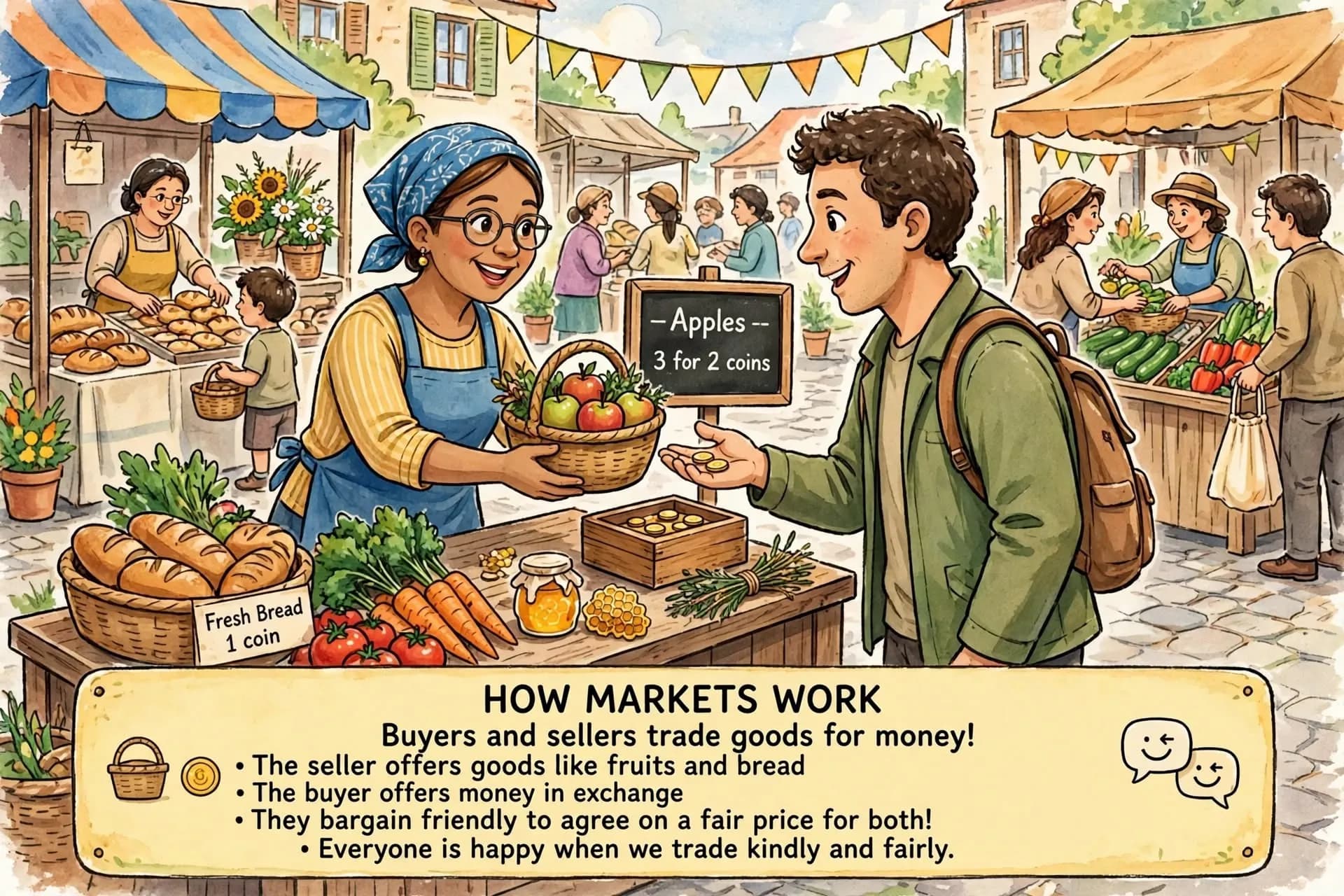
A market is any arrangement, place or system where buyers and sellers come together to exchange goods, services or ideas.
A market does not necessarily have to be a physical place.
A person buying clothes from a physical shop is participating in a market.
Similarly, a person buying a phone through an online platform is also participating in a market.
Markets perform several important functions. The major ones include:
One of the major functions of a market is to provide an opportunity for buyers and sellers to meet.
The seller has goods or services to offer, while the buyer has money or other means of payment.
A farmer brings tomatoes to the market, while consumers and traders come to buy them.
Therefore, the market provides a meeting point between the buyer and seller.
Markets make it possible for goods and services to be exchanged for money or other acceptable forms of payment.
A consumer gives ₦2,000 to a trader and receives goods worth ₦2,000.
The market therefore facilitates the exchange between the two parties.
Markets help in determining the prices of goods and services through the interaction of demand and supply.
Demand refers to the quantity of a product consumers are willing and able to buy at a given price and time.
Supply refers to the quantity of a product sellers are willing and able to offer for sale at a given price and time.
When the supply of tomatoes is high, prices may fall if demand does not increase correspondingly.
When tomatoes are scarce but demand remains high, prices may rise.
Markets help move goods and services from producers to final consumers.
This may involve:
Producer → Wholesaler → Retailer → Consumer
A manufacturer produces soap.
The soap is sold to a wholesaler.
The wholesaler sells it to retailers.
The retailer sells it to the final consumer.
The market facilitates this movement.
Markets provide information to buyers and sellers.
Information may include:
A trader can visit a market and discover that the price of a particular product has increased.
This information can influence the trader's buying and selling decisions.
Markets encourage competition among sellers.
When several businesses sell similar products, each business tries to attract customers.
They may compete through:
Several bakeries may compete by offering good-quality bread at attractive prices.
Competition can encourage businesses to improve their products and services.
Markets create employment opportunities for people.
People can work as:
Thus, markets contribute to people's livelihoods.
Markets encourage individuals and businesses to specialise in activities they can perform efficiently.
A farmer may specialise in producing vegetables, while another person specialises in transporting and selling the vegetables.
Through the market, they can exchange their products and services.
Markets make different goods and services available to consumers.
Consumers can select products according to their:
A consumer looking for school uniforms can visit a market and choose from different sizes, colours, designs and prices.
Markets provide a place or system through which commercial transactions can take place.
Sellers can offer products, while buyers can compare alternatives and make purchasing decisions.
Markets influence producers by showing them what consumers want.
If demand for a particular product increases, producers may increase production.
If consumers increasingly demand packaged fruit juice, producers may increase the quantity and variety of fruit juice supplied.
| Type of Market | Main Activity |
|---|---|
| Consumer Market | Exchange of goods and services for final consumers |
| Wholesale Market | Sale of goods in large quantities to retailers or other businesses |
| Retail Market | Sale of goods in smaller quantities to final consumers |
| Industrial Market | Buying and selling of goods used for business production |
| Agricultural Market | Exchange of agricultural products |
| Financial Market | Exchange of financial assets and services |
| International Market | Buying and selling between countries |
| Online Market | Buying and selling through digital platforms |
Markets are important because they: